



Choosing the right plastic stool looks trivial until you own the wrong one. Too low and it is useless at the kitchen counter; too light and it tips when a child climbs on it; too shallow in the stack and five of them still eat half your storage closet. This essential guide walks through the seven specifications that actually determine whether a plastic stool works, then maps them to the scenarios where you will use it.
Step 1: Get the Seat Height Right
Seat height is the single most common buying mistake. Measure first, then buy. A standard stool height of around 45–47 cm suits a normal dining table and general-purpose use; counter-height work requires roughly 60–65 cm; bar-height counters require 70–75 cm.
Xinlang's Modern Versatile Plastic Stool sits at 32 x 32 x 47 cm, a height that suits most users at a standard table or kitchen island while keeping a compact footprint. For elevated applications, the Elevated Leather-Top Stackable Stool provides additional height with a softer contact surface.
If the stool will be used primarily by children, a lower seat with a stable wide base is safer than an adult-height stool that encourages climbing.
Step 2: Check the Load Rating With a Margin
A stated load capacity should exceed your heaviest expected user by a comfortable margin. The Xinlang Multi-Scenario Plastic Stool is rated to 150 kg (330 lbs), which comfortably covers adult use across the weight spectrum.
Be skeptical of unspecified capacity. If a listing does not state a load figure, assume light duty. Also check where the load is applied: reinforced rim and seat-to-leg transitions are what allow a plastic stool to carry adult weight without rim cracking.
For step-stool use, dynamic load matters more than static load, because the user's weight lands with momentum. A 150 kg rating with reinforced geometry is the safer specification for that role.
Step 3: Verify Material Grade
Food-grade PP is the baseline for any stool that will contact food, be used by children, or sit in a kitchen. It is non-toxic, odorless in quality grades, waterproof and recyclable.
Ask whether impact modifiers are present. These additives are what stop a stool from cracking when dropped on a hard floor in cold weather — a failure mode that pure PP exhibits at low temperatures.
Xinlang builds its plastic stool range from high-quality non-toxic plastic aligned with its "Green Symbiosis" philosophy: durable against daily wear, lightweight for mobility, and recyclable at end of life.
Step 4: Inspect the Foot Design
Non-slip feet are a safety feature, not a nicety. Rubber or TPE feet prevent sliding on tile, polished concrete, laminate and hardwood, which is exactly where a lightweight stool is most likely to move unexpectedly.
The Xinlang multi-scenario stool adds non-slip rubber feet and a slightly textured seat surface, addressing both floor slip and seat slip. This matters most when the stool is used by children or elderly family members.
Check that the feet are seated flush and cannot pop out. A missing foot turns a stable four-point base into a rocking three-point hazard.
Step 5: Evaluate Stacking Depth and Storage
Stacking depth determines your real storage footprint. A shallow-nesting design lets five stools occupy barely more floor area than one; a deep-nesting design means five stools still occupy a meaningful corner.
Xinlang's plastic stools stack up to five units, and the geometry is designed so the stack separates easily rather than jamming. This is the feature that decides whether a stool set lives in your hallway or in your way.
For commercial and export buyers, nesting depth also drives carton quantity: Xinlang packs 12 pieces per carton, which lowers per-unit freight and storage cost.
Step 6: Choose Color Strategically
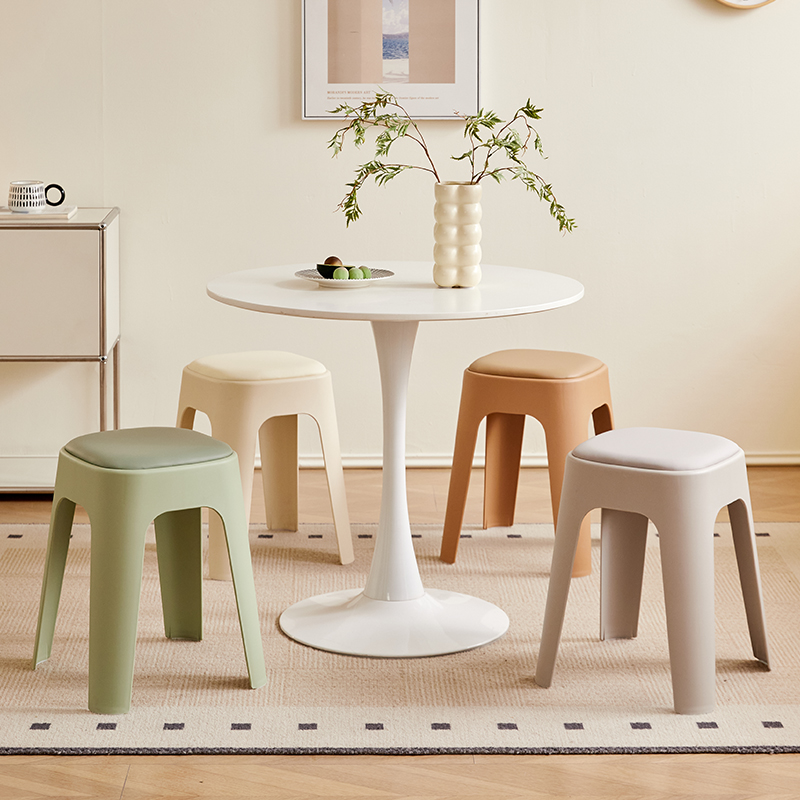
Neutral tones — soft white, gentle beige, neutral gray — disappear into minimalist and Scandinavian interiors and hide visual clutter in small rooms. Warm orange and deep brown act as deliberate accents in otherwise monochrome spaces.
In commercial settings, darker colors hide dirt between cleanings but show dust and lint more readily; lighter colors create an airy feel but demand more frequent cleaning. Choose based on your cleaning capacity, not only on aesthetics.
Xinlang stocks warm orange, soft white, gentle beige, neutral gray and deep brown, with custom color matching available for project orders.
Step 7: Match the Stool to the Scenario
Kitchen: step stool for high cabinets plus breakfast seating. Choose standard height, 150 kg rating, easy-clean surface. Bathroom: child reach and adult perch; waterproof construction is essential. Home office: client seating or a printer and book stand.
Garden and patio: weatherproof, UV-stabilized, light enough to carry outside and hose down. Retail and cafe: consistent color, stackable, high-traffic construction. Events and community spaces: maximum stackability and fast reconfiguration.
Where a softer seat is preferred, the Cushioned Stackable Plastic Stool and the Fabric-Top Two-Tone Stackable Stool offer upholstered contact surfaces while keeping the stacking and cleaning advantages of a plastic base.
Frequently Asked Questions (FAQs)
Q: What is the best height for a kitchen plastic stool?
A: For a standard dining table or kitchen island, around 45–47 cm works for most adults. For a raised counter, look at 60–65 cm, and for bar height, 70–75 cm. Measure the underside of your counter and subtract roughly 25–30 cm for comfortable leg clearance.
Q: Are plastic stools safe for children?
A: Yes, when they have a stable base, non-slip feet, rounded edges and an adequate load rating. Xinlang's one-piece integrated construction eliminates sharp corners and joint failure points, and the 150 kg rating covers adult supervision use as well.
Q: Can I use one stool type both indoors and outdoors?
A: A PP plastic stool is waterproof and corrosion-resistant, so moving it between kitchen and patio is fine. For permanent outdoor placement, request UV-stabilized material to protect against fading and surface chalking.
Q: How many stools should I buy for a household?
A: Four to six covers most households: two for daily use at the table, one dedicated as a step stool, and spares for guests. Because they stack five high, the storage cost of owning six is close to the cost of owning one.
Conclusion
Choosing the right plastic stool comes down to seven checks: height, load rating, material grade, foot design, stacking depth, color and scenario fit. Run through them before ordering and you avoid the two classic regrets — a stool that is the wrong height and a set that never gets stacked. Xinlang Furniture's plastic stool range covers standard, cushioned, fabric-top and elevated leather-top variants, all built on the same one-piece PP platform. Compare models across the Xinlang Furniture plastic stool range and request a quotation.