



Sourcing commercial seating is not really a product decision, it is a supplier decision. A chair sample can look perfect and still arrive in container three with thinner walls and a different additive package. This article sets out the criteria that distinguish a reliable plastic furniture manufacturer from a reseller, and shows how to qualify a factory before you commit to a container order.
Factory or Trading Company: Why It Changes Everything
A trading company can source a good sample and cannot guarantee consistency across production runs, because it does not control the mould, the material batch or the process parameters. A manufacturer controls all three.
Xinlang Furniture (Bazhou Xinlang Furniture Co., Ltd.) was founded in April 2016 and operates a 15,000 square meter facility with more than 80 skilled employees. That scale supports in-house injection moulding, quality inspection and packing under one roof.
For a buyer, factory-direct sourcing means the person who answers your technical question is the person who can change the process. It also means replacement units ordered two years later will match the original color and geometry.
Material Control and Traceability
In plastic furniture, the resin is the product. Ask what grade of PP is used, whether it is food-contact safe, whether impact modifiers and UV stabilizers are included, and whether the supplier can document material origin.
Xinlang aligns its material policy with a "Green Symbiosis" philosophy: high-quality non-toxic plastic that is durable enough for daily wear, light enough for easy mobility, and recyclable at end of life.
Documented material control is what allows a manufacturer to stand behind a load rating. The 150 kg capacity on the Multi-Scenario Plastic Stool is a function of resin grade and wall thickness, not a marketing claim.
Commercial-Grade Engineering Standards
Commercial seating is engineered against a different duty cycle than residential furniture: chairs moved many times daily, users of widely varying weight, harsher cleaning chemicals, and higher tolerance expectations from paying guests.
The engineering response is higher-grade plastics with UV stabilizers, impact modifiers that prevent cracking when a chair is dropped, fiberglass reinforcement at critical stress points, and thicker material at reinforced leg junctions and seat pans.
Xinlang applies more rigorous testing protocols and tighter quality tolerances for commercial orders, adjusting the manufacturing process to the stress patterns commercial use actually generates.
Product Range Depth Signals Manufacturing Capability
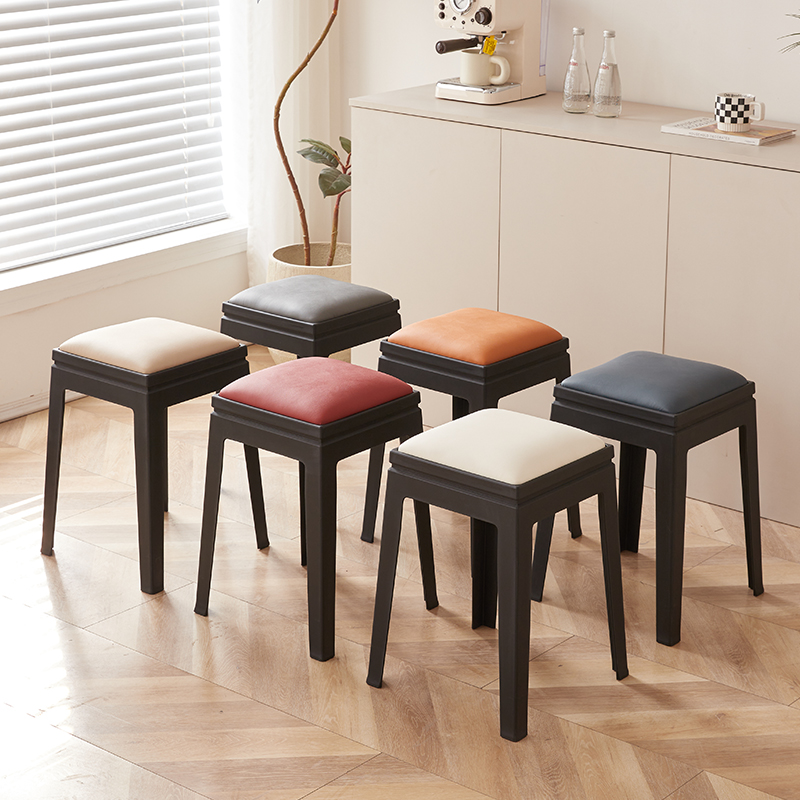
A broad, coherent product family is evidence of real mould investment. Xinlang's catalog spans Multi-Scenario Plastic Stool, Playful Character Plastic Stool, Modular Geometric Plastic Stool, Cushioned Stackable Plastic Stool, Fabric-Top Two-Tone Stackable Stool, Elevated Leather-Top Stackable Stool, Ergonomic Backrest Plastic Chair, Modern Swivel Armchair, Contoured Back Plastic Chair, Textured Shell Plastic Chair, Mobile Two-Tier Side Table and Minimalist Tripod Round Side Table.
Twelve distinct moulds across stools, chairs and tables means a buyer can furnish an entire venue — dining, lounge and side surfaces — from one supplier with consistent material and color language.
Range depth also reduces your freight and coordination cost: one container, one quality standard, one point of contact.
OEM and Customization Capability
For chain restaurants, hotel groups and retail brands, standard colors are rarely enough. Ask whether the factory can match a brand color, adjust dimensions, or vary material specification.
Xinlang offers personalized color matching, size adjustments and material variations on request, subject to order quantity. This is what lets a multi-site operator keep a consistent visual identity across every location.
Also confirm packaging options: Xinlang's standard 12 pieces per carton configuration can be adjusted for retail-ready or flat-pack requirements.
Questions to Ask Before You Place the Order
Ask about warranty terms and defect handling. Ask whether matching replacement chairs can be supplied months or years after your initial purchase. Ask about sample order policy, because evaluating a stool in your actual venue is the only reliable test.
Ask about lead time stability across seasons, and about export packing experience. A factory that has shipped containers knows how to pack to avoid scuffing in transit.
These questions reveal whether a supplier thinks long-term or simply wants to close a sale. Xinlang's approach emphasizes transparency, reliability and long-term satisfaction, and the company encourages detailed technical questions before ordering.
Frequently Asked Questions (FAQs)
Q: What is the minimum order quantity for commercial plastic seating?
A: MOQ depends on model and customization level. Standard stock models are typically available at lower minimums than custom-color or custom-size runs. Contact Xinlang Furniture with your target quantity and specification for a precise quote.
Q: How many chairs fit in a shipping container?
A: Container utilization depends on the model's nesting depth. Xinlang packs 12 stools per carton (carton size 40" x 40" x 115") for the Modern Versatile Plastic Stool, and chairs are packed to comparable density. Your forwarder can convert carton dimensions into a container plan.
Q: Can you supply replacement units years after the original order?
A: Yes, provided the model remains in production and the color is a stock or documented custom match. This is a key advantage of working directly with the manufacturer rather than a trading intermediary.
Q: Do you provide samples?
A: Sample orders can be arranged so you can evaluate the product in your actual environment before committing to larger quantities. This reduces risk and confirms that the final purchase meets your requirements.
Conclusion
A reliable plastic furniture manufacturer is defined by factory control, material traceability, commercial-grade engineering, catalogue depth and a willingness to answer hard questions before the sale. Evaluate those five things and the seating itself usually takes care of itself. Xinlang Furniture operates a 15,000 m2 facility with more than 80 skilled employees, producing plastic stools, plastic chairs and side tables for residential and commercial buyers worldwide. Start a conversation with the Xinlang Furniture technical team about your seating requirements.