



Three materials dominate the stool market and each has a genuine case. Wood looks warm, metal feels industrial-solid, plastic is light and waterproof. The right answer depends entirely on where the stool lives and how it is used. This guide compares plastic, wooden and metal stools across the eight criteria that determine real-world satisfaction.
Weight and Portability
Plastic wins outright. A PP plastic stool weighs around 1.2 kg (2.6 lbs), light enough for a child to carry and reposition. Wooden stools typically weigh three to five kilograms and metal stools similar or more.
Portability determines whether a stool actually gets used. A stool that is easy to carry gets moved to where it is needed; a heavy one stays where it was last put, which usually means someone improvises instead.
For venues that reconfigure seating daily, and for households where a stool moves between kitchen, bathroom and garden, this difference compounds over hundreds of moves per year.
Water, Weather and Corrosion Resistance
This is where plastic separates from the field. Polypropylene does not absorb water, does not swell, does not rust and does not corrode. A plastic stool can be rained on, hosed down and used again immediately.
Wood absorbs moisture, swells, warps and eventually cracks, particularly at joints. Painted or varnished wood delays this but requires re-coating. Metal rusts at welds and scratches unless it is stainless or well powder-coated, and even then the coating is a failure point.
For bathrooms, kitchens, patios, balconies, poolside and any outdoor application, plastic is the practical default.
Durability and Failure Modes
Wooden stools fail at joints — glue lines, screws and dowels loosen with repeated loading and humidity cycling. Metal stools fail at welds and coatings, and thin-gauge versions dent permanently.
Plastic stools fail by cracking, which is why impact modifiers and UV stabilizers matter so much. A well-specified PP stool with reinforced rim and leg geometry carries a 150 kg rating and returns to shape after loading.
Xinlang's one-piece integrated construction removes joints entirely, which eliminates the most common failure mode in both wood and metal alternatives.
Maintenance Requirements
Plastic: wipe with a damp cloth or rinse. No special products, no re-coating, no rust treatment. The non-porous surface repels stains and spills.
Wood: periodic oiling or re-varnishing, careful cleaning to avoid water damage, and joint tightening over time. Metal: coating inspection, rust treatment at chips, and occasional fastener tightening.
Over a five-year ownership window, the maintenance gap is substantial — and in commercial settings it translates directly into labor cost.
Comfort and Safety
Wood and metal feel colder on contact and harder under load; plastic has slight natural flex that many users find more forgiving. In cold climates, a metal stool outdoors in winter is genuinely unpleasant.
Safety favors plastic in family settings: one-piece moulded construction produces rounded edges with no sharp corners, no splinters, and no exposed fasteners. Xinlang's stools additionally use non-slip feet and a textured seat surface.
A 150 kg rating at 1.2 kg weight is a safety advantage too — a child can move the stool without risk of a heavy object falling.
Cost and Total Ownership
Upfront, budget wooden and metal stools can be cheaper than commercial-grade plastic, but the comparison shifts once replacement cycles are included. A plastic stool that lasts a decade outdoors versus a wooden stool replaced every three years is not a close call.
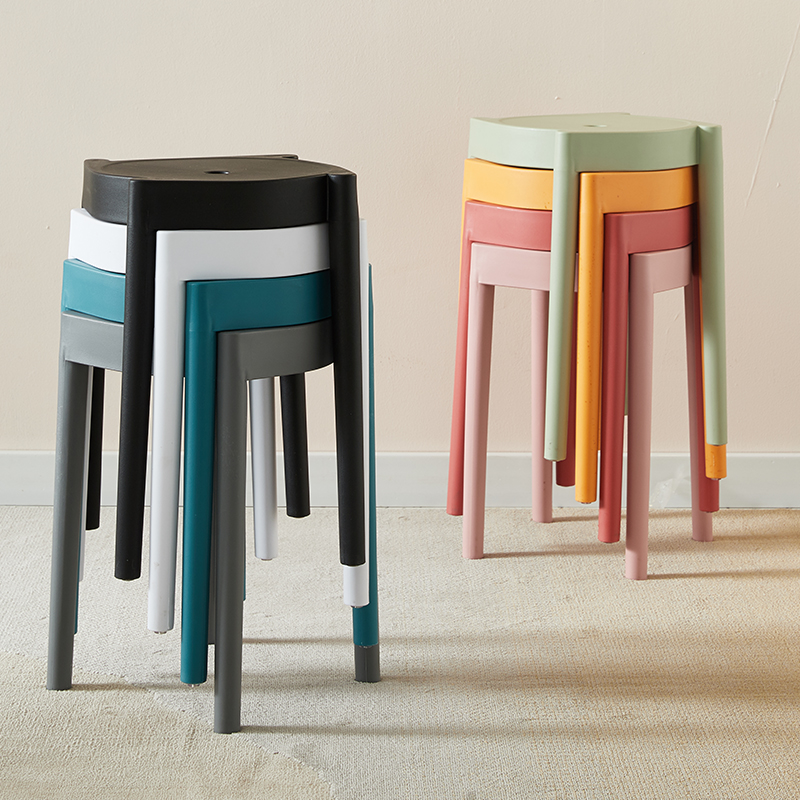
Shipping favors plastic: lighter units and stackable geometry reduce freight per piece. Xinlang packs 12 stools per carton, and the nesting design is what makes that density possible.
For commercial buyers, add cleaning labor and reconfiguration time, both of which favor lightweight stackable plastic decisively.
Aesthetics and Design Range
Wood wins on traditional warmth and metal on industrial character, but the gap has narrowed sharply. Modern injection moulding produces sculptural forms — textured shells, contoured backs, geometric and playful character designs — that read as intentional design statements.
Xinlang's range demonstrates this: Modular Geometric Plastic Stool, Playful Character Plastic Stool, Textured Shell Plastic Chair and Minimalist Tripod Round Side Table all use the same material in visually distinct languages.
Integrated color also means scratches do not expose a contrasting substrate, which keeps plastic looking better longer than painted alternatives.
Environmental Considerations
Wood is renewable but often finishes with coatings and adhesives; metal is recyclable but energy-intensive; PP is recyclable and lightweight, reducing transport emissions.
Durability is the dominant environmental factor. A stool that lasts ten years and is then recycled has a lower footprint than a cheaper one replaced three times in the same period.
Xinlang's "Green Symbiosis" approach pairs non-toxic, recyclable PP with durability designed to extend replacement intervals.
Frequently Asked Questions (FAQs)
Q: Which stool material is best for outdoor use?
A: Plastic. PP is waterproof, corrosion-resistant and impact-proof, so rain, humidity and temperature cycling do not degrade it. Request UV-stabilized material for permanent full-sun placement.
Q: Are plastic stools strong enough for adults?
A: Yes when properly specified. Xinlang's Multi-Scenario Plastic Stool is rated to 150 kg (330 lbs) thanks to reinforced rim and leg geometry, despite weighing only about 1.2 kg.
Q: Do plastic stools look cheap in a designed interior?
A: Not in current moulded designs. Textured shells, contoured backs and curated neutral palettes let plastic seating read as deliberate. Integral color also means scuffs do not expose a different material underneath.
Q: Which material is easiest to maintain?
A: Plastic, by a wide margin. A damp cloth or a rinse is the entire routine, with no re-coating, rust treatment or joint tightening.
Conclusion
Wood wins on tradition, metal on industrial character, and plastic on everything that affects daily ownership: weight, weather resistance, maintenance, safety, freight and longevity. For kitchens, bathrooms, gardens, patios and commercial venues, polypropylene is the stronger specification. Xinlang Furniture's plastic stool, chair and side table ranges are engineered around those advantages with OEM customization available. Compare stool, chair and side table models across the Xinlang Furniture range.